

Web design for contractors and home service businesses
A website that turns someone searching on their phone into a phone call.
★★★★★4.8 on Google from 53 reviews
What does a contractor website actually need to do?
A contractor website has one job: turn a person searching on their phone into a phone call. That means a call button on every page, a page for each service, photos of finished jobs, reviews in plain view and fast loading on a phone. Telos Creative builds these sites for trades in Fort Collins, Loveland, Greeley and across Northern Colorado, from our office in Windsor.
Most people find a contractor on a phone, often while standing in front of the problem. They want to know three things quickly: do you do this, do you work where I live, and can I trust you. Everything on the site should answer one of those or lead to the call.
Updated November 2026
Which contractors have we built websites for?
Real trades, and each project page shows what the site had to do.
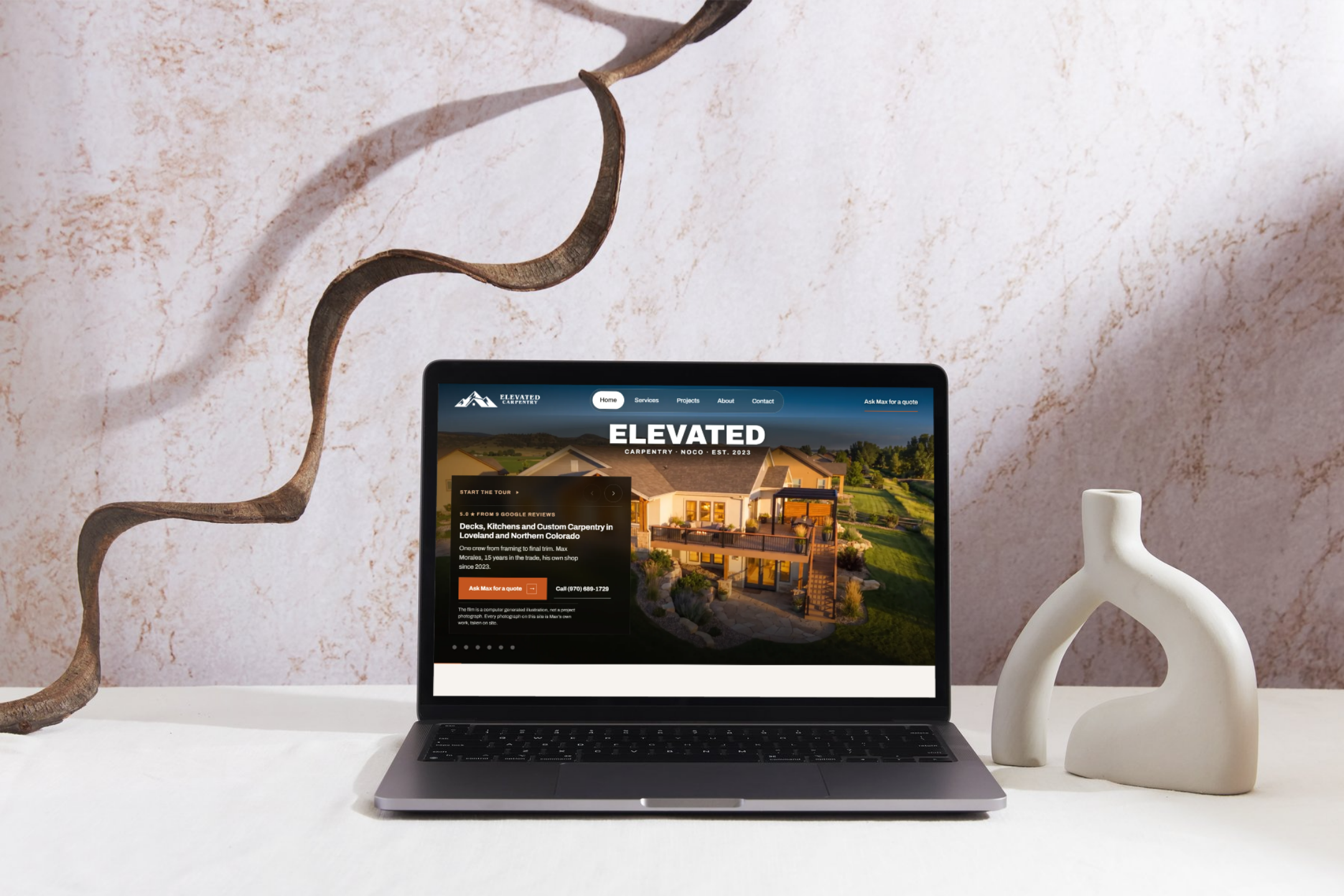
- Elevated CarpentryA Loveland general contractor doing decks, kitchens and custom carpentry. The site answers the question homeowners really have, whether the contractor will vanish, with the owner by name.
- C&S Rain GuttersA family-owned gutter company in Greeley, running since 2003. Five service pages cover installation, guards, repair, cleaning and snow stops, with a free estimate one tap away.
- The Squeegee PullerA one-operator window cleaning business in Greeley. Residential, commercial and screen repair split cleanly, and booking is built in.
- Legacy PaintingA painting company with no website and no logo when it came to us. We built both from the ground up, with galleries of the crew’s work.
- Fort Collins BathA bathroom remodeler in Fort Collins, and the line its site leads with: “Old shower at breakfast. New shower by dinner.”
“Arnold built me a website I couldn’t believe. I had dumped a ton of money in other companies and had a couple of run down websites before him and I had given up on even trying to fix them.”
Max Morales, Google review, September 2026
What is included in a contractor website from Telos?
The words, the design, the build and the local SEO setup, so you are not coordinating four vendors.
- Your message and copy, written for youWe start with a StoryBrand BrandScript and write every page around it. You approve the words before design starts.
- A page for every serviceEach one says what the job involves, what affects the cost and what the customer needs to decide, with photos of that kind of job.
- A custom WordPress buildDesigned for phones first and kept fast, so you can update it without calling a developer.
- Local SEO set up at launchTitles, headings and service areas are in place on day one. For ongoing work on rankings, see contractor SEO and marketing.
Most sites go from kickoff to launch in about 2 to 4 weeks, and a project with new branding takes 8 to 10. To plan a budget, read how much a website costs. The full list is on our web design service page.
What should the top of a contractor home page show?
The first screen on a phone is the most valuable space you have.
- What you do and whereOne plain line, with the main service and the towns. “Landscape design and installation in Loveland and Fort Collins” tells a visitor more than a slogan does.
- A call buttonTappable, in a contrasting color, labeled with the action (“Call for a quote”) rather than “Contact”.
- A second, quieter optionA short form or a quote request for people who cannot talk right now.
- One line of proofYour Google rating and review count, years in business or the number of jobs completed, whichever is true and strongest.
- A real photoYour crew’s finished work. Stock images of a smiling homeowner say nothing about you.
Why should every service have its own page?
Because people search for the job.
Someone who wants a new patio types patio installation. Google decides local results partly on relevance, meaning how well what you offer matches the search. A page that is entirely about patios, with the towns you build them in, matches better than a list.
The other half of being found is your Google listing, reviews and service area. We cover those in Google Business Profile management and in SEO for contractors in Loveland.
What photos should a contractor put on their website?
Your own, as many as you can, of real finished work.
- Before and after pairsThey are the most persuasive, because they show the size of the change.
- A line under each projectWhat the job was, which town it was in and roughly how long it took. That one line turns a nice picture into evidence, and gives the page words that match how people search.
- Keep them lightPhotos straight off a phone are often several megabytes each. Resize them first. Google’s image guidance also asks for descriptive file names and alt text.
- Ask before you photograph a homeMost customers say yes, especially if you leave out the address. Asking also tends to start the conversation that ends in a review.
How fast does a contractor website need to load?
About two and a half seconds on a phone.
That is the threshold Google’s guidance on Largest Contentful Paint describes as good, and Google measures it on real visitors’ phones, which are a lot slower than office Wi-Fi. The usual culprits are oversized photos, an autoplaying video at the top and a pile of add-ons that each load their own code.
Should a contractor website list the towns it serves?
Yes, plainly and in one place.
The list should match the service area on your Google Business Profile. A visitor in Windsor wants to see Windsor before they call, and a consistent list is one more signal that you are the business you say you are.
A page for a town is worth writing when you have something real to say about working there: projects you have done, local permits, the conditions you deal with. Pages that only swap the town name help nobody, and Google’s guidance on helpful content is clear about pages made mainly to rank.
How do you know if your website brings in work?
By counting it.
Taps on the phone number and form submissions can both be recorded in Google Analytics and marked as key events, so you can see how many came from search, from your Google listing and from everywhere else. Check it against your own inbox and call log every so often, because tracking breaks quietly and spam fills forms.
For the wider picture of how a trade gets more calls, see home service marketing. If you want to see structure in action, our project work and StoryBrand website examples show it.
See where you stand before you decide
Your free audit shows your map next to the competitor taking your calls, your grade, and the fixes worth the most.
Questions contractors ask about their websites
Do I need a website if most of my work comes from referrals?
Yes, because referrals check you out before they call. Someone given your name by a neighbor will search for it, look at your photos and read your reviews. A clear website confirms the recommendation. No website, or an outdated one, makes them wonder whether you are still trading.
Should a contractor put prices on their website?
Some guidance beats silence. Exact prices are rarely possible, but a typical range, what moves it up or down and what a normal project looks like will keep people on the page who would otherwise leave to find someone who told them something.
How many pages does a contractor website need?
A home page, one page for each service you want to be hired for, a page of finished projects, an about page and a contact page. A landscaping company might have eight to twelve pages in total. Add more only when each one has a job of its own.
Can I use stock photos on my contractor website?
Use your own wherever you can. Customers are deciding whether to trust you with their property, and photos of your finished jobs are the strongest evidence you have. Stock photos are easy to spot and say nothing about your work. Photos taken on your own phone are fine.
Do I need to show my address on my website?
Not if you work from home and go to customers. List your phone number, the towns you serve and your hours instead, and keep those details identical to your Google Business Profile, where Google also allows a service area business to hide its address.
Is a website template good enough for a contractor?
A template can work if it is fast on a phone, puts the call button at the top and gives every service its own page. Many templates do none of those by default. The template matters less than whether someone has set it up around how your customers actually search and call.
See how your site does on a phone right now
Run the free audit, or book a call and Arnold will come out to the job site if that is easier.

Prefer to talk now? Call (970) 581-1398, Monday to Friday, 8:00 to 4:00 Mountain.