

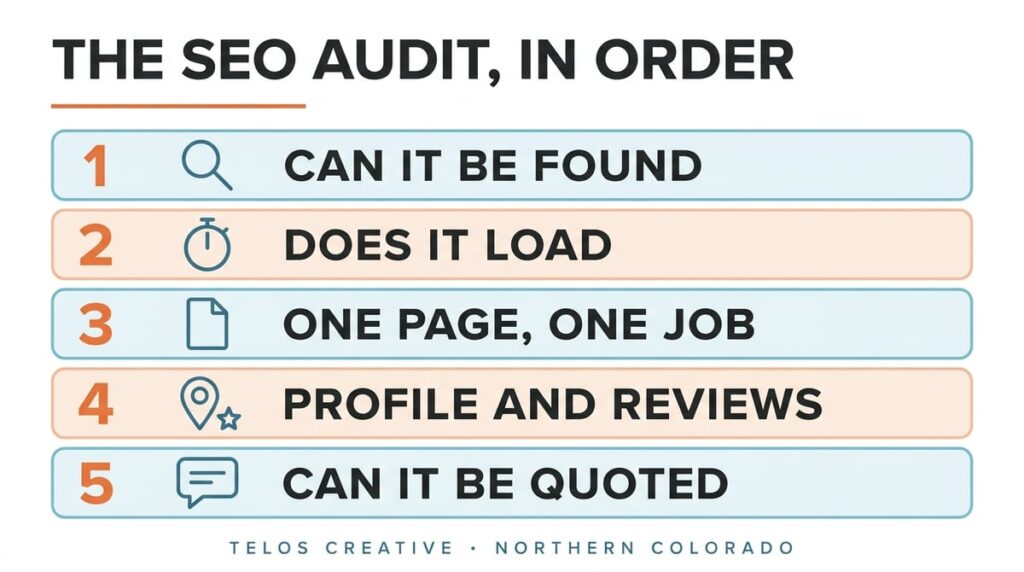
This is the checklist we run on every new site, in full, in the order we run it. It is six passes: can the site be found, does it load, does each page have a job, the local half, is it answer shaped, and what we deliberately skip. Everything here can be done with free tools and your own browser. There is no gate and nothing held back. Telos Creative is a marketing agency in Windsor, Colorado.
Work top to bottom. The order is deliberate, because a finding near the top can make everything below it irrelevant, and most published audit checklists are sorted by category rather than by what actually matters.
What You Need Open
Four things, all free: Google Search Console for the site, Google Analytics, the site itself in a browser, and your Google Business Profile login. If Search Console is not set up, stop and set it up. Auditing a site without it is guessing, and the verification takes a few minutes.
Write findings down as you go with a one word priority next to each: now, soon, or never. The never pile is as useful as the other two, because the point of an audit is to decide what to ignore as much as what to do.
Pass One: Indexation And Crawling
This pass decides whether anything else counts. Do not skip ahead.
Are your pages actually in the index
In Search Console, open the Pages report and compare the number of indexed pages against the number of pages you believe you have. A gap is the finding. Then use the URL Inspection tool on your three most important pages individually and read what it says, rather than assuming.
Is anything blocking the crawler
Open your robots.txt file by adding /robots.txt to your domain and read it. Look for Disallow lines covering anything you want found. Then view the source of a key page and search it for the word noindex. Both of these take a minute and both have been the entire explanation for a site’s invisibility more than once. Google documents the behavior of robots.txt if you need to check a rule.
Does the sitemap exist and is it submitted
Check for /sitemap_index.xml or /sitemap.xml, confirm it lists your real pages and not a stale set, and confirm it is submitted in Search Console. A sitemap is not a ranking factor. It is a way of making sure nothing is missed.
One version of the site, not four
Type all four variants by hand: with and without www, http and https. All four should end up at the same address with a redirect, not load separately. Then check that important pages have a canonical tag pointing at themselves rather than at something else.
Is every internal link a real destination
Crawl the site with any free crawler, or click through it if it is small, and list anything returning a 404 or chaining through multiple redirects. Fix the links rather than adding redirects where you can, because a redirect is a patch and a corrected link is a fix.
The cautionary case we quote most often is our own. A page of ours sat live for over a month, present in the sitemap, linked from the footer, and Search Console still reported it as unknown to Google. Being published is not being indexed, and footer links are not enough to get a page discovered. Give every important page at least one contextual link from a page that gets crawled often.
Pass Two: Speed And Mobile
Test on mobile and judge on mobile. Desktop numbers on a modern machine flatter almost every site and are not what most of your visitors experience.
The three numbers that are defined, and their thresholds
Google’s Core Web Vitals are the only speed metrics with published pass marks, assessed at the 75th percentile of real page loads. Largest Contentful Paint should be 2.5 seconds or less. Interaction to Next Paint should be 200 milliseconds or less. Cumulative Layout Shift should be 0.1 or less. Check the field data in Search Console rather than only the lab score, because field data is what real visitors got.
Does it work on a real phone
Load the site on your own phone on mobile data, not office wifi. Tap the phone number and see whether it dials. Fill in the contact form and see whether it sends and where the message arrives. Try it one handed. This finds more revenue affecting problems than any speed report, and almost nobody does it.
Weight and images
Look at the page weight in your browser’s network tab. On most local business sites the problem is uncompressed images and duplicated tracking scripts rather than anything exotic. Both are cheap to fix and both are worth fixing before anyone starts rewriting code.
Pass Three: Does Each Page Have A Purpose
This is where most of the value in an audit sits, and where automated tools are least useful.
List every page and write its job next to it
One line each: what question does this page answer, and for whom. Any page you cannot write a line for is a candidate for merging or removal. This exercise alone usually reshapes a small site more than anything technical.
Are two pages doing the same job
Search your own site for your main service term using site: followed by your domain and the phrase. If three pages come back all trying to win the same search, they are splitting the effort between them. Pick the one that should win, and make the others link to it and cover something genuinely different.
Titles and headings
Every page needs one H1 that says what the page is. Title tags should read like something a person would click, with the service and the place in them, and should not be identical across pages. Check the titles as they appear in a search result rather than as they look in your CMS, because truncation changes what is actually read.
Does the page say where you work
Surprisingly often, a service page never names its town. If a page is meant to bring in work from a specific place, that place needs to appear in the copy in a natural sentence, not only in a footer address.
Pass Four: Profile, Consistency And Reviews
For a local business this pass frequently produces more inquiries per hour spent than everything else combined.
Work through the profile properly
Primary category exactly right, secondary categories used but not stuffed, real hours including holidays, services listed, photographs that are yours and are recent, and a description that says what you do and where. Google names relevance, distance and prominence as what decides local results, and the profile is where you influence relevance most directly.
Name, address and phone, identical everywhere
Pick the exact format you use, down to whether there is a suite number and how the street is abbreviated, and check it matches on your website, your profile, and every directory you appear on. Small inconsistencies are not fatal individually and they add up to every source disagreeing slightly.
Reviews: volume, recency and replies
Count how many you have against the three businesses that outrank you. Look at the date of the most recent one. Check whether anyone has replied to them. Google states plainly that more reviews and positive ratings can help local ranking, and a profile whose last review is two years old reads as a business that may have closed.
Service area set correctly
If you go to customers rather than them coming to you, the address should be hidden and the service area should reflect where you actually go. Google asks that a service area not extend much beyond roughly two hours of driving time from your base.
Pass Five: Can It Be Quoted
The newest pass, and the cheapest to act on. The full reasoning is in our guide to AI visibility for local businesses.
Read your own opening lines out of context
Take the first two sentences under each main heading and read them as if someone quoted them at you with no surrounding page. Do they answer the question on their own? If they depend on a pronoun or on the paragraph above, rewrite them. This is the single highest value edit on most sites.
Does the structured data exist and match
View source and search for the word schema. Confirm there is LocalBusiness markup and that what it claims matches what is visible. Question and answer markup describing an FAQ a visitor cannot see is a guidelines violation rather than a clever trick.
Does the content survive without JavaScript
Disable JavaScript and reload your most important page. Google renders JavaScript before indexing so it usually copes, but several other crawlers do not, and anything that only appears after scripts run is invisible to them. Make your website AI readable goes through this properly.
The Filler We Deliberately Leave Out
Most audit reports are long because length reads as thorough. Here is what we do not check and why, so you can skip it too.
Keyword density
There is no target percentage and there has not been for many years. Writing to hit one produces worse copy that is easier to spot as written for a machine.
Third party authority scores as a goal
Domain authority style metrics are invented by the companies that sell them and are not used by Google. They are occasionally useful for comparing two link sources quickly. Treating the number itself as a target leads directly to buying links, which is a policy violation with real downside.
Meta keywords, and most meta tag housekeeping
The meta keywords tag has been ignored for well over a decade. A long list of missing or duplicate meta tags fills pages in a report and moves nothing unless the title and description are genuinely bad.
Every W3C validation warning
Markup validation errors are worth fixing when they break rendering or block a crawler. A list of four hundred nesting warnings on a site that renders correctly everywhere is padding.
A single score out of 100
Useful for triage and nothing else. Any number that combines speed, tags and content into one figure has hidden the only interesting part, which is which of those is the problem.
The test for whether a finding belongs in an audit at all: can you say what would change for the business if it were fixed? If the answer is more calls, more of the right visitors, or a page becoming findable, it goes on the list. If the answer is that a number in a tool would go up, it does not.
Questions We Get Asked About SEO Audits
How long does an SEO audit take?
Working through this checklist yourself on a small local site takes most people a focused afternoon, longer if you find real problems and stop to fix them. A thorough audit done properly by someone experienced is usually two to five days of work, most of which is interpretation rather than data collection. An audit delivered in an hour is a tool’s output with a cover page on it.
What is the difference between a free SEO audit and a paid one?
A free audit is almost always automated. It checks the things software can check reliably: response codes, page speed, missing tags, broken links, basic markup. That part is genuinely useful and there is no reason to pay for it. A paid audit should be the part software cannot do, which is judgment about your market, your competitors and which of the findings actually matter for your business.
How often should I audit my site?
A full pass once a year is enough for most local businesses, plus a short check after anything structural: a redesign, a platform change, a move to a new domain, or a sudden drop in inquiries. Auditing monthly mostly generates work. The things worth watching monthly are your inquiry numbers and Search Console coverage, not the whole list.
Do I need paid tools to do this?
No. Everything on this checklist can be done with Google Search Console, Google Analytics, your own browser and a Business Profile login, all of which are free. Paid crawlers save time on larger sites and make some of the checks faster, but they do not find anything here that you cannot find without them on a site of twenty or thirty pages.
My audit report gave my site a score out of 100. Is that meaningful?
Only as a rough triage. Those scores are a weighted count of rule violations from one tool, not a measure of how well a site performs in search. A site can score in the nineties and rank for nothing, and a site scoring in the sixties can dominate its market. Use the individual findings, ignore the headline number, and never let a score become the goal.
What should I fix first if everything is broken?
Indexation first, because nothing else matters if your pages are not in the index. Then the Business Profile, because for a local business it is often the fastest route to more calls. Then the answer shape of your two or three most important pages. Leave the technical tidying that affects nothing visible until those three are done.
If you would rather not run the technical half by hand, our free audit does exactly that part automatically against your live site. The judgment passes above are still worth doing yourself, because you know your market better than any tool does. Related reading: AI visibility for local businesses and why AI does not mention your business. We are based in Windsor and work across Fort Collins, Loveland, Greeley and Longmont on search and website work. Arnold Jakobsen founded Telos Creative and is a StoryBrand Certified Guide.