

Contractors get found differently to shops and offices, and the difference is the map. Most of the work goes to whoever appears in the three local results at the top of the page, and those are decided largely by your Google Business Profile, your reviews and how close you are to the person searching. For a Loveland trades business the order is: fix the profile, get the service area right, earn reviews steadily, then build the pages that answer what customers actually ask. Telos Creative is a marketing agency in Windsor, Colorado, a short drive up the road.
This page covers what works for trades specifically, not general advice with the word contractor added. Where an example is needed we use landscaping throughout, so nothing here is drawn from a client’s own market.
You Are Not Competing For The Same Page
Four differences change what is worth doing, and all four push in the same direction.
You go to the customer, so distance works differently
A shop has one location and customers come to it. You cover an area, and the search results change depending on where the person searching is standing. Someone in one part of Loveland and someone on the other side of town can see different businesses for the same search. That is normal, it is not a fault, and it means your visibility is a map rather than a position.
The map results take the attention
For a search with local intent, the block of three business listings with the map sits above the ordinary results. Getting into that block is usually worth more than any single ranking below it, and it is decided by different things.
Jobs are large and infrequent
Customers are spending real money on something they will live with, and they are often nervous. They will check your reviews, look at your work and form a view before calling. This is why photographs of finished jobs and clear answers do more for a trades business than clever wording.
Inquiries arrive as phone calls
Which means a lot of what happens is invisible in analytics, and it makes the phone number on a mobile screen one of the most important elements on your site. Make sure it dials when tapped, and make sure it is near the top.
Set The Profile Up The Way Google Expects
More contractor profiles are set up incorrectly than correctly, and the fixes are free. Google publishes the rules for service area businesses plainly.
Hide the address if you work out of your home
Google’s guidance is explicit: if you run the business from a residential address and travel to customers, clear the address from the profile. An address shown on a profile is supposed to be somewhere staffed that can receive customers during the stated hours. Hiding it costs you nothing.
Set a service area you would actually drive to
Google asks that the overall service area not extend much beyond about two hours of driving time from where the business is based. From Loveland that comfortably covers Fort Collins, Greeley, Windsor, Longmont and most of the Front Range. It does not cover the whole state, and claiming it does makes the profile less accurate without making you appear further away.
One profile per staffed location, not per town
If you have genuinely separate locations with their own staff and their own service areas, you are allowed a profile for each. Creating extra profiles for towns where you have no premises is a guideline breach and risks the profile you depend on.
Categories, services and hours
Pick the primary category that describes what you mainly do, add the secondary ones that genuinely apply, list your services individually rather than as one lump, and keep the hours honest including the ones you do not work. Then add photographs of real finished jobs, taken on your own phone, regularly.
The Three Things That Decide Local Results
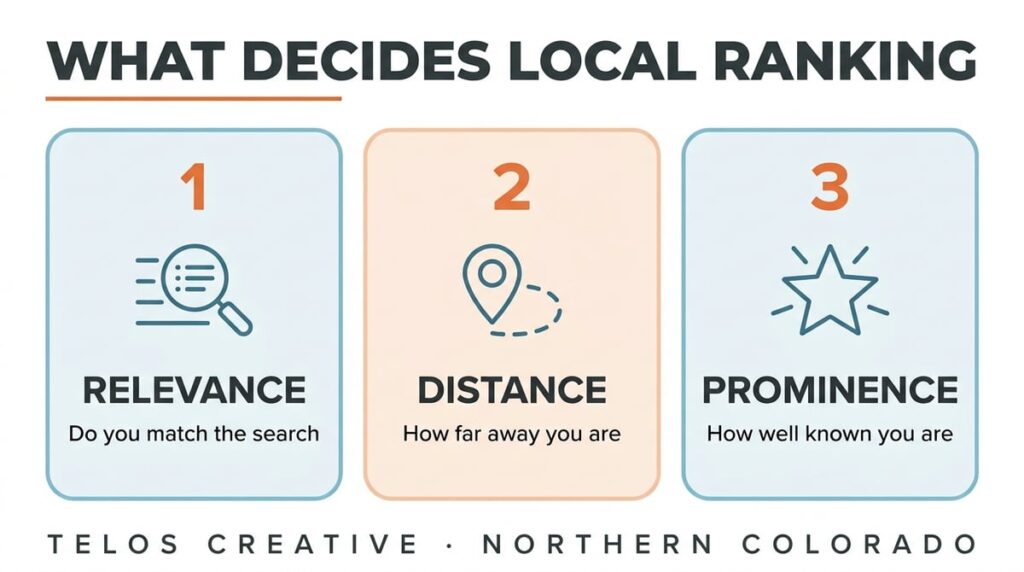
Google publishes this rather than leaving it to be guessed at, and it is worth reading in the original: local results are decided by relevance, distance and prominence.
Relevance
How well your profile matches what was searched. This is the one you control most directly, through categories, services and the words on your site. A landscaper who lists only one service will not match searches for the others.
Distance
How far you are from the person searching. You cannot change where you are. You can make sure your service area is set correctly so you are eligible across it, and you can accept that a business based in the middle of a town has an advantage there.
Prominence
How well known you are, which Google says draws on things like links and reviews. This is where most of the available improvement sits for a typical contractor, and it is the slowest of the three to move.
And what Google says you cannot do: there is no way to request or pay for a better local ranking. Any offer to buy a position in the map results is not what it claims to be. We go through the rest of the warning signs in what SEO should cost around here.
The Small Number Of Pages That Do The Work
A contractor site does not need to be large. It needs a few pages that each do one job properly.
One page per service, written like an answer
Not a list of services on one page. One page for each thing you sell, saying what it involves, what it typically costs to think about, how long it takes and what the customer needs to decide. Name the service and the place in the opening sentences so the passage stands on its own if it is quoted somewhere else.
A page for a town only when you have something to say about it
Real reasons exist: a permit process, a soil or drainage quirk, a type of property common in one area, the fact that you have done forty jobs there. Those make a page worth reading. Swapping the town name in an otherwise identical page does not, and Google is good at spotting the difference.
Proof, in quantity
Photographs of finished work, ideally before and after, with a line about what the job involved. For a trades business this is the highest value content there is, it costs nothing but the time to take the pictures, and almost nobody does it consistently.
The prices question, answered honestly
Most contractors will not put numbers on a website and that is understandable. Something is still better than silence. A range, what moves it up and down, and what a typical project looks like will keep people on the page who would otherwise leave to find a competitor who told them something.
The Part That Carries More Weight Than You Think
Google states directly that more reviews and positive ratings can help local ranking, and for a trades business they also do most of the persuading before anyone calls.
Ask everyone, at the right moment
The moment is when the job is finished and the customer is visibly pleased, in person, before you leave. Follow up with a direct link the same day. Asking only the customers you expect to be enthusiastic is against Google’s policies and it also produces a review profile that reads as curated.
Steady beats a burst
A few a month, continuously, is worth more than thirty in a fortnight and then silence. Recency is visible to customers as well: a profile whose most recent review is from two summers ago reads as a business that may have stopped trading.
Reply to all of them, including the bad one
A calm, specific reply to a poor review does more good than the review did harm, because the next customer reads how you handle problems. Do not argue, do not explain at length, say what you did about it.
Go And Look At What Your Competition Is Doing
This is worth ten minutes and it is more persuasive than anything we could assert here, so rather than quoting a statistic we cannot stand behind, check it yourself.
Search your main service with Loveland on the end. Take the businesses in the map block and the first few results, and for each one note four things: when they last posted a photograph on their profile, when their most recent review was left, whether the owner has replied to any of them, and whether their website has a separate page for the service you searched. Write it down as a small table.
What people generally find is that the list is patchy. Some competitors are doing this properly and are hard to displace. Others have profiles that have not been touched in a year. The gap between those two groups is the part of the market that is actually available to you, and the exercise also tells you which of the four things above is worth your attention first.
Run our SEO audit checklist against your own site afterwards and you will have both halves of the picture: what your market is doing, and what state you are in. Both are free and neither needs a tool you have to pay for.
Questions We Get Asked By Contractors
Do I need a website if my Google Business Profile brings in work?
Yes, and the profile is the reason why. Google decides what to show partly on prominence, and a profile with nothing substantial behind it has less to draw on than one backed by a site that explains the work, shows it and answers the questions customers ask. The profile is also rented. The site is the part you own, and it is where a customer checks you out before calling.
Should I hide my address if I work out of my home?
Yes. Google’s own guidance for service area businesses is to clear the address from the profile if you run the business from a residential address and go to customers. Hiding it does not hurt your ranking and showing an address you do not receive customers at is against the guidelines, which puts the profile at risk.
How big should my service area be?
As big as you will genuinely travel, and no bigger. Google asks that the overall service area not extend much beyond roughly two hours of driving time from your base. Listing half the state does not make you appear across it, because distance from the searcher is one of the things Google weighs, and it makes your profile less accurate.
Is it worth making a page for every town I serve?
A small number of real ones, yes. A page per town generated by swapping the place name, no. Google treats mass produced near identical pages as low quality and it is a common way for a contractor site to get itself into trouble. Write a page for a town only when you have something specific to say about working there.
How do I get more reviews without annoying customers?
Ask once, in person, at the moment the job is finished and the customer is pleased, then follow up with a direct link. Ask everyone rather than only the ones you expect to be enthusiastic, because filtering who you ask is against Google’s policies. A steady few a month is worth more than a burst, and reply to all of them.
How long before this brings in calls?
Profile work can move within weeks, sometimes faster, because it is the part with the most slack in it on most contractor profiles. Website work is slower and usually shows over a few months. If someone promises a transformation before the end of the season, ask them what specifically will cause it.
Our free audit checks the technical side of your site in about a minute. If you would rather talk it through, we are in Windsor, a short drive from Loveland, and we are happy to come to you: get in touch. More on how we work locally: SEO in Loveland, marketing in Loveland and website design in Loveland. Related reading: AI visibility for local businesses. Arnold Jakobsen founded Telos Creative and is a StoryBrand Certified Guide.