



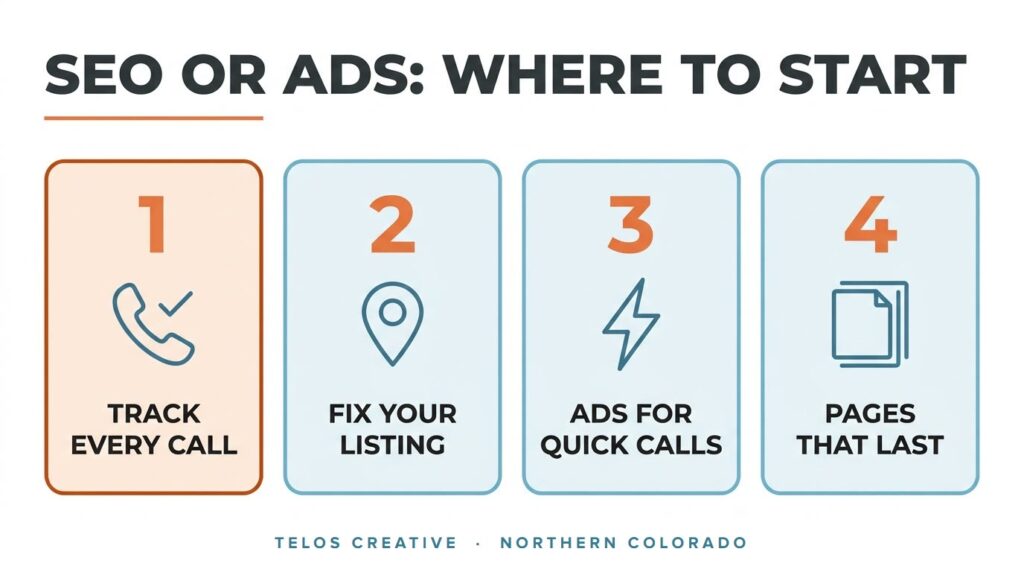
For most local small businesses, start with the basics of SEO, a clear website and a complete Google Business Profile, and use Google Ads to bring in calls while those build up. SEO takes time and keeps working after you stop paying for it. Google Ads cost money for every click and stop the day you switch them off. We run both for businesses in Fort Collins, Loveland and across Northern Colorado.
Below: how the two differ, when ads should come first and when SEO should, what each one costs, and what to check before you spend on either. The figures come from real accounts we manage, with the names withheld.
What Is The Difference Between SEO And PPC?
PPC stands for pay per click. On Google that means Google Ads, the sponsored results at the top of a search. As Google puts it, with cost-per-click bidding “you’ll pay only when someone actually clicks on your ad and comes to your site.”
SEO, search engine optimization, is the work that earns you a place in the unpaid results and on Google Maps: the right pages, a complete Google listing, reviews and links. Nobody can buy those places. Google says it “doesn’t accept payment to crawl a site more frequently, or rank it higher” in its guide to how Search works.
- Speed. Ads can show the day the campaign goes live. SEO usually takes months.
- Cost. Ads charge for every click. SEO costs the work, whoever does it.
- When you stop. Ads stop when the budget stops. Pages and a strong listing keep bringing in searches.
- Control. With ads you choose the searches and the wording. With SEO, Google decides where you show.
When Should A Small Business Start With Google Ads?
When you need calls soon and you can count them. Ads make sense first when:
- You have just opened, or added a service, and nothing of yours ranks for it yet.
- The work is seasonal and you need the phone to ring this month.
- You want to learn which searches turn into paying jobs before you write pages for them.
- Your calls and forms are tracked, so you can see what each one costs.
An example
A home service company we took over from another agency on 1 September 2026 (name withheld). In the 24 days before, its ads brought 3 calls for $747, or $249 a call. In September they brought 20 calls for $1,193, $60 a call, and in October 18 calls for $1,316, $73 a call. Google Search clicks cost about $10. What changed: tracking set up first, ads aimed at the service area, and the search terms read every week.
That is the work in our Google Ads management. Two months is a short read, and we say so.
When Should You Start With SEO Instead?
When ads would waste money. SEO, or at least its basics, should come first when:
- You cannot count calls and form leads yet, so nobody could tell which ads pay.
- The budget is too small to learn from. At about $10 a click, a few hundred dollars buys only a few visits a week.
- Your website or Google listing would let the visitor down. People who click an ad still read your reviews and look at your site before they call.
- You already show on Google Maps for the searches that matter, and paying for the same customers would add little.
An example
A local service business (name withheld) got 15 leads in 3 months from paid ads. It paused them, and with its pages and listing doing the work it brought in 19 quote requests in August 2026 and 19 again in September, on $0 of ads.
That is the kind of work our SEO services cover: the Google listing, the pages, the directories and the reviews, with the numbers on a live dashboard.
Which Costs More, SEO Or Google Ads?
Neither is free, and they cost in different ways. Ads cost the clicks plus the time to manage them, and the spend never ends while you want the calls. SEO costs the work, and what it builds keeps working after the work slows down.
Do the math before you start. On the home service account above, Google Search clicks ran about $10 in the fall of 2026, so $1,000 a month buys roughly 100 visits. If about one visit in ten becomes a call, that is ten calls. Click costs change a lot between trades and towns, so we estimate yours from the searches before we set a budget.
Check where the money goes. One home service account we read in October 2026 had spent $5,443.62 in ten months. Google Search got $15.43 of it, and the Display Network $5,368.76. The one conversion it recorded was a visit to its About page. None of this shows on a monthly bill.
Can You Run SEO And Google Ads At The Same Time?
Yes, and they help each other when someone reads both sets of numbers together.
- The search terms report from your ads shows the exact words that bring calls. Those words are the pages worth writing for SEO.
- Ads cover the searches you do not rank for yet. As your pages climb, you can turn the matching ads down.
- The same landing page serves both: one page per service, answering what people ask before they call.
On the account above, about half of the October calls came from people searching the company’s own name. Those people were already looking for it, so check how many name searches an ad budget is paying for.
What Should You Check Before You Spend On Either?
- Tracking. Every call and form counted, so you can compare what Google reports with your inbox.
- Where the ads show. Search first. Display and other placements only with a reason and a way to measure them.
- One page per service. Someone searching for a service should land on the page about that service.
- Your Google listing. Complete, with photos and recent reviews, because people check it either way. See our Google Business Profile management.
- Promises. Google itself says “No one can guarantee a #1 ranking on Google” in its guide Do you need an SEO? Be wary of anyone who does.
Questions We Get Asked About SEO And Google Ads
Is PPC the same as Google Ads?
PPC means pay per click, any advertising where you pay when someone clicks. For most local businesses it means Google Ads: the sponsored results at the top of a Google search.
How long does SEO take to work?
Months, not days. Our own Google Maps listing went from 2 to 44 spots in the Maps top 10 for “web design fort collins” between May and October 2026. A new page can show in Google within days, but steady positions take longer.
Can I stop Google Ads at any time?
Yes. You can pause a campaign whenever you like, and the ads stop showing. That is also the catch: the calls they brought in stop with them.
Do Google Ads help my SEO?
Not directly. Google says it does not accept payment to rank a site higher, so ad spend does not move your unpaid position. The search terms report from your ads is still useful, because it shows which words bring calls.
Should I pay for ads on my own business name?
Sometimes. If a competitor advertises on your name, a small brand campaign can protect those calls. If nobody does, people searching your name usually find you anyway, so check how many of your ad calls are name searches before you keep paying for them.
What does a small business need before either one?
A way to count calls and form leads, a page for each service you want to sell, and a complete Google Business Profile. Without those, neither SEO nor ads can show you what is working.
Not sure which to start with? Our free website audit checks your website and your Google listing and shows where you stand, or get in touch and we will look at your numbers with you. More reading: website lead generation and how to respond to Google reviews. Arnold Jakobsen founded Telos Creative and is a StoryBrand Certified Guide.